
CUI BONO BUKELE'S BIT-CON?

© Jeffrey Robinson 2021
When El Salvador’s President Nayib Bukele made bitcoin the nation’s legal tender, surveys showed 70-95% of Salvadorans don’t want to be forced to use this crap.
So the question is cui bono - who benefits.
The short answer must be Bukele and his mates. Except, it’s not that simple.
A man of leftist-liberal political origins, he is now the face of far right conservatives. (Sound familiar?) While wildly popular, Bukele is hardly the slick, young, swashbuckling populist he pretends to be.
Particularly worth ignoring by bitcoin fans, he is actively usurping political power by copying the playbook of dictators and autocrats who have created a totalitarian regimes around the world.
To start, he changed the law which would allow him to run for a second term. Then he used his office to crush two political parties that have opposed him, invaded the National Assembly with armed soldiers, fired the attorney general who was investigating corruption in his government, fired the five judges who sit on the Constitutional Chamber of the Supreme Court after they began demanding that the rule of law be applied to reign in his political ambitions and put yes-men in their place, demanded the National Assembly exempt his government from expenditure disclosures, ordered the arrest of a former president and several former ministers and gone to war against any critical media. He is also planning the overhaul of the nation’s constitution and specifically plans to eliminate the restriction on one-party rule.
For what it’s worth, the US State Department recently named 14 corrupt politically powerful Salvadorans, eleven of whom are known associates of Bukele. They include his chief of cabinet, his minister of labor, his vice minister of security, and his legal adviser. Washington even imposed sanctions, which means certain members of El Salvador’s government are banned from entry to the US.
Now along comes the "bitcoin as legal tender” ploy.
I contend that all these things are related, that the move towards bitcoin is part of Bukele’s overall ambition to eventually become president for life - the local version of Hugo Chavez - and hold a death-grip on El Salvador’s economy. It’s no coincidence, given that Venezuela adopted its own cryptocurrency, the Petro, which is mandated as the official currency for government document services and payment of airplane fuel used on international flights.
The difference here is that Bukele went two-steps further. First, he declared bitcoin “legal tender”, forcing it to co-exist with the genuine legal tendered US Dollar. (El Salvador dropped its own Colon currency in 2001, using the dollar specifically to stabilize the nation’s chaotic economic life. Until now, it’s worked.)
Next, he declared bitcoin “forced tender,” which may sound great but is, in reality, economic malpractice. It means, in El Salvador, if someone offers to pay you in bitcoin, you must accept it, whether or not you want it. It’s a concept implemented by the Soviets during their 75 year Communist rule over Russia. We all know how well that worked out.
Interestingly enough, before making this move, Bukele did not publish any suitable studies by academics or economists - people with recognized credibility - who could asses the pros and cons of the legal tender declaration. He didn’t do it because he knew what the results would be and couldn’t afford to tell the nation the truth - that the experiment is doomed to fail.
That is, unless Bukele can keep his thumbs on the scale.
After all, here’s a country where only around one-third of the population have access to the Internet, and in several areas, the people don’t even have electricity. And in those cities where there is Internet service, the capital San Salvador for example, it is prohibitively expensive. Much of the free $30 worth of bitcoin that Bukele has used to bribe citizens to subscribe to his government backed bitcoin wallet, has already been cashed out. It was almost immediately turned it back into real money because $30 in impoverished El Salvador can feed a child for a month. At the same time, Internet fees in San Salvador can range upwards from $33. In the wilds of the countryside, it can be much more expensive.
In other words, most of Bukele’s citizens cannot afford his politically motivated pipedream.
According to journalists on the ground, Bukele has now poured well over $200 million into this new law. He has also spent more than $25 million buying bitcoin to support it, with funds from the national treasury. Within ten days of the law coming into effect, he’d already lost 10% on his bitcoin purchases.
On the surface, his rationale for imposing bitcoin on an unsuspecting population comes from the misguided belief that bitcoin allows for quicker and cheaper remittances from outside the country. It does not. Bitcoin is, arguably, the worst of the crypto payment systems. He also said that bitcoin will permit the unbanked to become banked. There is no evidence, anywhere in the world, that this has ever happened. And, he said, it will attract foreign investment. So far, there are plenty of seats available on flights to San Salvador.
He’s stated he wants crypto-entrepreneurs and miners to set up businesses in the country. In response, several bitcoin snakeoil salesmen and grifters showed up to cheer him on, predicting that this is the first of many nations to “legal tender” bitcoin. It goes without saying, they’re full of crap. There is no indication that any of Bukele’s promises are happening, or will happen. Or that the various snakeoil guys coming down from the States are in it for anything more than sustaining the grift.
To that point, there have been large protests on the streets of several Salvadoran cities objecting to the mandatory imposition of bitcoin.
*****
Now look beneath the surface. Because there is more to Bukele’s “bit-con” than meets the eye.
As Mayor of the small town of Nuevo Cuscatlán, he was faced with severe gang violence. It was hardly surprising, given that the entire country was suffering one of the highest gang-related murder rates in the world.
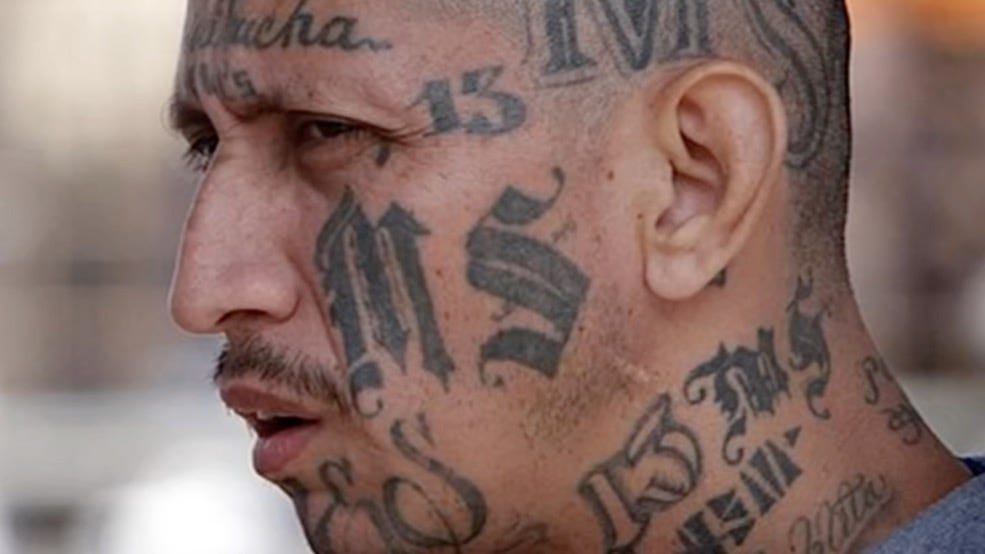
The gang behind much of this was MS-13.
Originally formed on the inner-streets of Los Angeles, the MS stands for “Mara Salvatrucha.” And while there are several explanations for the name, it likely derives from La Mara, a street in San Salvador, and from Salvatrucha, the name of the guerrillas who fought in El Salvador's civil war. The number 13 either refers either to the LA street where the group was formed, or to the Salvatrucha’s civil war that began in 1979 and didn’t end until 1992, which is 13 years.
Currently active throughout North America, Mexico and Central America, to put this bunch into perspective, the gang’s official motto is “Murder, rape, control.”
A well organized criminal enterprise, their business is sex trafficking, prostitution of young children, auto theft, protection rackets, loan sharking and degenerate violence.
In dealing with the murder problem in Nuevo Cuscatlán, Mayor Bukele stood accused of working out a deal with MS-13. He denies it. But the murder rate apparently, and mysteriously, dropped. In 2012, the then government also negotiated a truce with MS-13 that went some way towards reducing gang violence. Although the idea of negotiating with MS-13 remains repulsive to many citizens.
As President, Bukele has taken a public stance in condemning MS-13, promising to fight gang violence and has categorically denied that he or any member of his government has or would negotiate with them. He also denies MS-13 endorsed his campaign, or supported it in anyway. Although critics have their doubts, at least where campaign contributions are concerned.
At the same time, the El Faro newspaper - Latin America’s first on-line newspaper - obtained hundreds of reports that demonstrated how Bukele’s government has been meeting gang leaders since 2019. As a result, the paper and other sources confirm, Bukele’s representatives and MS-13 have agreed to reduce the number of murders in the country.
In exchange for what?
The must stated answer is, prison privileges for MS-13 members held in Salvador's jails.
I’m suggesting a more significant answer is, bitcoin.
Given the nature of Bukele’s government, the jury is still out on how his move towards bitcoin-as-legal-tender could wind up lining the pockets of cronies. (An idea not to be dismissed.) But how can there be any doubt that perhaps the number one beneficiary has to be MS-13.
Until now, bitcoin has not only failed dismally as a currency, it has not succeeded when it comes to money laundering. Yes, there are instances of it being used in trade base money laundering on the Dark Web, where some bad actors have been able to turn their ill-gotten gains into bitcoin and traded that for goods and services that further their criminal activities. But as a straight forward mechanism for money laundering, bitcoin is useless.
Until now for MS-13, that is, thanks to Nayib Bukele.
Say you’re a drug trafficker with $5 million you’ve taken off the inner-city streets. You need to consolidate the haul. But converting so many $5, $10 and $20 bills into bitcoins isn’t easy. First, you have to find someone dumb enough to take your cash. Then, because the bitcoin market is so shallow, that guy is not only going to ask a big fee, he’s going to insist on converting small amounts strung out over a lot of days.
But you’re a trafficker. This isn’t a one-time deal. You’ve got cash coming in all the time and you need to move it quickly. Next week you’ve got $5 million more. That creates a recurring problem for the guy selling bitcoins. If he can somehow manage those transactions for you, all he winds up every week is the same problem you’ve just solved – what to do with $5 million in street cash.
Okay, say he’s turned your cash into bitcoins. The blockchain technology is super-efficient and you can move your stash effortlessly back home to Colombia.
Then what? You must get out of bitcoins and into dollars or pesos, again risking alarm bells in a shallow market and paying high fees for the privilege.
At this point, all you’ve got for your trouble is $5 million, minus a lot of commissions, in cash. In truth, you haven’t laundered anything. You’ve just displaced your original problem.
But now, if you’re MS-13, President Bukele - and his corrupt pals - has given you a way to launder your dirty money effortless, and legally, from the streets of North America back to El Salvador, where you have his blessings to “force transfer” it into local investments.
Bukele has said he wants bitcoin’s legal tender status to attract money from overseas and further the economic development of the nation. While one is hard pressed to find any major bitcoin investments headed to El Salvador, it’s a sure bet that his homeboys at MS-13 will take him up on it.
But now ask yourself, how long will it take the world to see that Bukele’s cynical facilitation of MS-13’s criminal enterprises outside the country is not a suitable price to pay for reducing violence at home just to keep him in power?
*****